
I love being able to see what the weather is doing without having to reach for my phone, and a home weather station gives you those answers at a glance. How cold did it get overnight? How much rain have we actually had? What’s the temperature in the garden right now?
It’s not just weather enthusiasts who find them useful. Gardeners can keep an eye on frost and rainfall, while anyone who spends a lot of time outdoors can check the conditions before heading out. If you have a greenhouse, allotment or simply enjoy knowing exactly what’s happening in your own little patch of the world, a weather station can be a surprisingly useful addition to the home.

The best weather stations can monitor everything from indoor and outdoor temperature and humidity to rainfall, wind speed, wind direction and air pressure.
There’s also something quite satisfying about having your own set of weather data. Instead of simply being told what the forecast is for your area, you can see what’s happening right outside your own door.
I’ve looked at what the different types of home weather stations can do and the features worth considering, followed by some of the models available to buy in the UK.
Here’s a quick comparison glance, with full product details below:
| Weather Station | Best for | Key features |
|---|---|---|
| U-UNNI | Everyday weather watching | Indoor/outdoor temperature and humidity, weather forecast, moon phase, max/min readings |
| LIORQUE | Large, easy-to-read display | 7.5-inch screen, temperature and humidity, weather forecast, barometric pressure, moon phase |
| AIR6 | Affordable full weather monitoring | Temperature, humidity, rainfall, wind speed and direction, barometric pressure |
| Ecowitt WS2910 | Detailed local weather data | Temperature, humidity, rainfall, wind, UV, light levels, solar radiation and Wi-Fi connectivity |
U UNNI Basic Weather Station – Best for Everyday Weather Watching
If you mainly want a simple way to keep an eye on the weather at home, the U UNNI weather station is a good option without getting into the more complicated features of higher-end models.
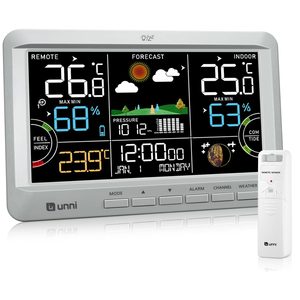
It shows indoor and outdoor temperature and humidity, with readings available in °C or °F, along with a weather forecast display, maximum and minimum temperatures, moon phase and a handy comfort indicator. The display also includes a feel index and other information about current conditions.
The weather forecast uses changes in barometric pressure to determine its weather icons. U UNNI recommends allowing around 7–10 days for the station to calibrate, so the forecast display can become more accurate over time.
The MSF radio-controlled clock automatically keeps the time accurate, while the main display can be powered by AC with three brightness settings. There’s also a battery backup, although the batteries aren’t included.
The outdoor sensor has a 100-metre transmission range and the system can support up to three sensors, which could be useful if you want to monitor conditions in different parts of the garden.
Best for: Anyone who wants an affordable, straightforward home weather station for checking temperature, humidity and general weather conditions at a glance.
LIORQUE Wireless Weather Station – Best for a Large, Easy-to-Read Display
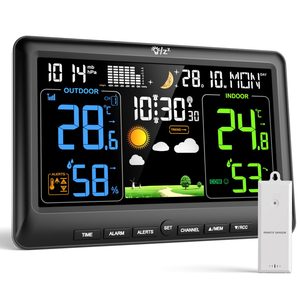
If you like being able to glance across the room and see your weather information clearly, the LIORQUE weather station has a particularly useful 7.5-inch LCD display. It can sit on a table or be wall-mounted, making it suitable for anywhere you want to keep an eye on the weather.
It shows indoor and outdoor temperature and humidity, along with a weather forecast, weather trends, barometric pressure, moon phase and the time and date. The forecast display includes seven different weather icons, from sunny and cloudy to rain and snow.
The radio-controlled clock automatically keeps the time accurate and adjusts for seasonal time changes, you can choose between 12 and 24-hour time and even change the weekday display between seven languages.
The display can be powered by the mains and left on continuously, with four brightness levels to choose from. It can also run on batteries, although the batteries aren’t included; in battery mode, the screen lights up for around 10 seconds when you touch the button.
The included outdoor sensor has a 100-metre range, and the station can support up to three sensors if you want to monitor conditions in different areas.
Best for: Anyone who wants a larger, easy-to-read display with plenty of weather information, without moving up to a more advanced multi-sensor weather station.
Ecowitt WS2910 Weather Station – Best for Detailed Weather Monitoring
If you’re genuinely interested in what’s happening with the weather around your home, the Ecowitt WS2910 offers considerably more information than a basic indoor/outdoor thermometer.
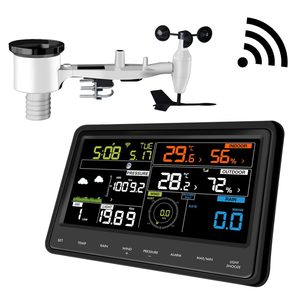
Its 7-in-1 wireless outdoor sensor measures temperature, humidity, rainfall, wind speed, wind direction, light and UV levels, with a built-in solar panel to help power the sensor. The sensor has a transmission range of up to 100 metres and sends updated readings to the display every 16 seconds.
The colour LCD console gives you a lot of information at a glance, including indoor and outdoor temperature and humidity, rainfall, wind conditions, air pressure, UV index, solar radiation, dew point, wind chill and heat index. It also records daily maximum and minimum readings, so you can see how conditions have changed throughout the day.
For anyone who enjoys keeping track of their local weather, the Wi-Fi connectivity is a particularly useful feature. Once connected, you can view your live readings through the Ecowitt or WS View Plus app, as well as upload your weather data to services including Weather Underground, Weather Cloud and the Met Office’s WOW network.
The outdoor sensor can be powered by its solar panel or two AA batteries, while the indoor display uses either mains power or three AAA batteries.
Best for: Gardeners and weather enthusiasts who want detailed information about rainfall, wind, temperature and other local weather conditions, rather than just a basic temperature reading.
AIR6 Wireless Weather Station – Best Affordable Full Weather Station
If you want more than just the temperature but don’t want to spend as much on a more advanced weather station, the AIR6 is a good middle-ground option.
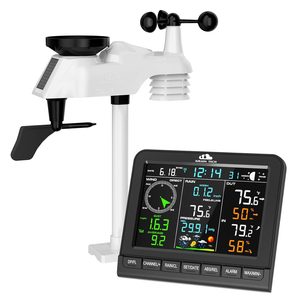
It monitors indoor and outdoor temperature and humidity, rainfall, wind speed, wind direction and barometric pressure, giving you a useful picture of what’s happening around your home. It also displays the weather forecast and moon phase, while calculating dew point and wind chill.
The 6.5-inch colour display makes the information easy to see, with adjustable brightness so you can set it to suit the room. The outdoor sensor wirelessly sends readings back to the display from up to 100 metres away, so there’s no need to run cables between the sensor and the main unit.
The outdoor sensor includes a rain gauge, anemometer and temperature and humidity sensors, and comes with an adjustable mounting bracket for straightforward installation.
Unlike the Ecowitt WS2910, the AIR6 doesn’t offer Wi-Fi or app connectivity, but that’s also what makes it a simpler option. If you mainly want to see your local temperature, rainfall and wind conditions at a glance, it covers the key measurements without the extra complexity.
Best for: Anyone looking for an affordable weather station with rainfall and wind measurements, without needing Wi-Fi or advanced weather data features.
Why Use a Home Weather Station?
A weather app can tell you the forecast for your area, but a home weather station gives you something different: your own measurements from your own garden or property.
Weather can vary quite a bit even over relatively short distances. A weather station lets you see what is actually happening where you live, rather than relying entirely on a regional forecast.
Here are some of the reasons people enjoy having one at home.

See What the Weather Is Actually Doing
One of the simplest reasons to have a weather station is curiosity. You can see the temperature outside, how humid it is, how much rain you’ve had and, with more advanced models, how fast the wind is blowing and which direction it’s coming from.
It’s particularly interesting to check your readings alongside the forecast. Was last night’s temperature really as low as predicted? How much rain did you actually get? Is it windier in your garden than the forecast suggested?
Over time, you can also start building up a picture of the weather around your own home.
Keep an Eye on the Garden
For gardeners, having local weather information can be genuinely useful.
Knowing how much rain you’ve had can help you decide whether plants need watering, while temperature readings can help you keep an eye on cold nights and changing conditions through the seasons.
More advanced weather stations can also measure things such as humidity, wind, UV levels and rainfall, giving you much more information than a basic weather app.
If you’re growing vegetables, keeping a record of local conditions can also be an interesting way to see how the weather affects what you’re growing.
Check Conditions Before Heading Outside
A home weather station can also be handy if you spend a lot of time outdoors.
You can check the temperature and conditions before heading out for a walk, working in the garden, camping or doing other outdoor activities. If your station measures wind and rainfall as well, you’ll have a better idea of what’s happening outside before you leave the house.
It’s not a replacement for a proper forecast, particularly when you’re planning something where changing weather could be important. Instead, it gives you another source of information about the conditions at home.
Track Rainfall and Temperature Over Time
One of the interesting things about having your own weather station is that you can look back at your readings rather than just seeing today’s forecast.
Depending on the model, you may be able to record daily minimum and maximum temperatures, rainfall, humidity and wind conditions. Some Wi-Fi weather stations can also store and display your data through an app.
This can be particularly interesting if you enjoy keeping records of your garden or simply want to see how this year compares with previous seasons.
A Fun Way to Learn About the Weather
You don’t have to be a serious weather enthusiast to enjoy having a weather station.
Watching the readings change throughout the day can be fascinating, particularly during periods of heavy rain, strong winds or big changes in temperature. They’re also a simple way to introduce children to things like temperature, rainfall, wind direction and the changing seasons.
And if you find yourself becoming increasingly interested in the numbers, a more advanced weather station gives you plenty more to explore.
Home Weather Station FAQs
For many people, yes. A home weather station gives you your own local readings for things like temperature, humidity, rainfall and wind, rather than relying solely on a regional forecast. They’re particularly useful for gardeners, outdoor enthusiasts and anyone who simply enjoys keeping track of the weather around their home.
The best home weather station depends on what you want to measure and how much information you need. A simple model is enough if you mainly want to check temperature and humidity, while more advanced stations can also measure rainfall, wind, UV levels and other conditions. If you want detailed local weather data and Wi-Fi connectivity, the Ecowitt WS2910 is one of the more comprehensive options featured above.
This depends on the model. Basic weather stations usually measure indoor and outdoor temperature and humidity, while more advanced models can also measure rainfall, wind speed and direction, air pressure, UV levels and solar radiation. Some can also connect to Wi-Fi, allowing you to view and record your weather data through an app.
Place the sensor somewhere open and well away from walls, sheds, trees and other sources of heat or shelter that could affect the readings. If it measures wind and rainfall, avoid areas where buildings or overhanging branches could block the wind or rain. Always check the manufacturer’s instructions, as the recommended height and positioning can vary between models.
No. Most basic home weather stations work without Wi-Fi, using a wireless outdoor sensor to send readings to the display inside your home. Wi-Fi is mainly useful if you want to view your weather data through an app, store readings over time or access them when you’re away from the display.
Most home weather stations provide useful readings, but accuracy varies between models and can also depend on where the outdoor sensor is positioned. Placing it correctly, away from direct heat, sheltered areas and other sources of interference, will help you get more reliable readings. For everyday gardening and weather watching, a good-quality home weather station can provide a useful picture of conditions around your home.
Choosing a Home Weather Station
Whether you’re a keen gardener, spend lots of time outdoors or simply enjoy watching the weather change, a home weather station is a fun way to get to know the conditions around you a little better.
You don’t need the most advanced model either. Choose one that gives you the information you’re interested in, whether that’s temperature and rainfall or a much more detailed picture of the weather.
There’s something quite satisfying about looking out of the window and knowing exactly what the weather is doing in your own little corner of the world. Why not start keeping an eye on yours?


